
UEC has launched the Player Development Reward Online Simulator, showing how the PDR policy could work in practice for clubs across Europe. The policy would direct at least 5% of UEFA Club Competition revenues towards clubs that develop players who later create value in European competitions. UEC wants to see the PDR implemented by UEFA in the new 2027–31 revenue distribution cycle.
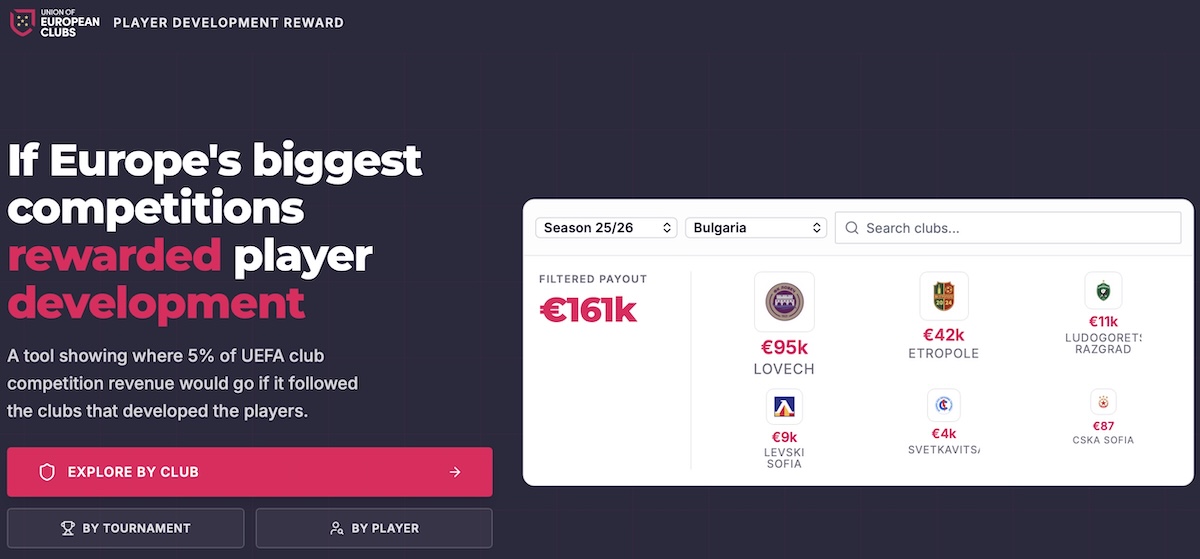
The Union of European Clubs has launched a new Player Development Reward Online Simulator, allowing clubs and stakeholders to see how the PDR policy could work in practice.
The Player Development Reward is designed to recognise the clubs that identify, train and develop players who later create value in UEFA Club Competitions.
Under the policy, at least 5% of UEFA Club Competition revenues would be directed back towards development clubs. The value attributed to players is calculated using their share of competition minutes and the prize money earned by their clubs in the relevant UEFA competition, before being distributed among eligible clubs involved in their development between the ages of 12 and 19.
The new online tool turns that policy into a practical model. Using real player development histories, UEFA competition minutes and prize-money data, users can explore estimated PDR outcomes by club and by player and see how the mechanism could affect clubs across European football.
One example highlighted by the simulator is FC Hertha 03 Zehlendorf. The fifth-tier German club could have received around €892,000 across the five seasons modelled for its role in the development of Antonio Rüdiger.
The figures shown by the simulator are estimates rather than confirmed payments, but they demonstrate how a recurring reward for player development could provide meaningful support to clubs that contribute to the production of elite-level talent.
UEC would like to see the Player Development Reward policy incorporated by UEFA into the new 2027–31 revenue distribution cycle.
The policy is intended to complement existing training compensation and solidarity mechanisms by creating a direct and recurring link between the value generated by players in UEFA competitions and the clubs that helped develop them.
With discussions around the next UEFA revenue distribution framework taking shape, UEC believes the 2027–31 cycle provides an important opportunity to strengthen the recognition of player development across the European game.
Clubs, leagues, national associations, media and other stakeholders are encouraged to explore the simulator and see what the Player Development Reward could mean in practice.
Explore the Player Development Reward Online Simulator: https://uecplayerreward.eu
